


.jpg)
Hair Straightening Curly Hair – The Complete Practical Guide for Pakistani Women
Hair straightening for curly hair is one of the most requested topics among Pakistani women who manage naturally textured, wavy, or coiled hair. While curly hair is beautiful and increasingly celebrated, there are occasions — formal events, professional settings, family functions, or simply days when you want a change — when smoothing curls into a sleek, straight style is exactly what you are after. Done correctly, hair straightening for curly hair can look stunning and last for days. Done incorrectly, it can cause significant damage that takes months to undo.
The challenge is that curly hair does not straighten the same way that wavy or straight hair does. It has different structural properties, different moisture needs, and different responses to heat. Approaching hair straightening for curly hair with the wrong tools, the wrong preparation, or the wrong technique produces results that are either disappointingly half-straight or badly damaged. This guide addresses all of these issues directly and explains how the Beurer HSE 40 hair straightener — available at Rs. 16,000 through Beurer Pakistan — provides the specific features that curly-haired Pakistani women need for safe, effective, and lasting straightening results.
The Science Behind Why Curly Hair Is Harder to Straighten
To straighten curly hair effectively, it helps to understand what creates and maintains the curl pattern in the first place. Curl pattern is determined by two main factors: the shape of the hair follicle at the scalp and the arrangement of disulfide bonds within the hair shaft. Round follicles produce straight hair, while oval or irregular follicles produce wavy or curly hair. The internal disulfide bonds — a type of chemical bond stronger than the hydrogen bonds that heat styling temporarily reshapes — are arranged asymmetrically in curly hair, which is what makes curls resilient and resistant to straightening.
Heat styling for hair straightening in curly hair works on the hydrogen bonds — the temporary bonds that hold the hair's shape in its current state. When sufficient heat is applied, these bonds break and reform in the new straight shape as the hair cools. However, because curly hair has more structural resistance than straight or wavy hair, it takes more heat, more even plate contact, and slower, more deliberate passes to thoroughly break and reform those bonds into a straight pattern. This is why precision temperature control and wide, even-heating plates matter so much for curly hair specifically.
Moisture Management Before Hair Straightening Curly Hair
One of the most important and most overlooked aspects of hair straightening for curly hair is moisture management before the styling session. Curly hair is naturally more porous than straight hair, which means it absorbs moisture from the environment readily but also loses it faster. Before attempting to straighten curly hair, understanding your hair's current moisture level is essential.
Curly hair that is well-moisturised straightens more easily and holds the straight style longer than dry, brittle curly hair. This seems counterintuitive — more moisture means more resistance to drying out, which makes it harder to straighten? — but the reality is that properly moisturised hair has a smooth, intact cuticle surface that responds more evenly to heat. Dry, damaged curly hair has a lifted, rough cuticle that is both harder to press flat with a straightener and more prone to frizzing and reverting after styling.
Two to three days before a hair straightening session with the HSE 40, give your curly hair a deep conditioning treatment. This infuses moisture into the cortex, smoothes the cuticle layer, and prepares the hair structure to respond more cooperatively to the heat styling process. On the day of straightening, wash with a smoothing or anti-frizz shampoo and conditioner, and follow with a leave-in conditioner applied to still-wet hair before blow-drying.
The Blow-Dry Stage – More Important for Curly Hair Than Any Other Type
Before the Beurer HSE 40 even touches your curly hair, the blow-drying stage is critical. This is not optional or a time-saving shortcut — it is a foundational step in the entire hair straightening process for curly hair. Using a powerful Beurer hair dryer and a round brush, begin drying your hair section by section, stretching each section taut as you dry to begin the straightening process before the flat iron is applied.
This pre-stretch technique during blow-drying serves two essential functions. First, it removes all moisture from the hair so that no residual dampness is present when the flat iron contacts the hair — wet hair under a hot flat iron causes the trapped moisture to steam inside the shaft, permanently damaging the hair structure from within. Second, it begins to elongate the curl pattern, meaning the flat iron needs to do significantly less work to achieve a fully straight result. Section-by-section blow-drying with tension is the single most underrated step in hair straightening for curly hair.
Sectioning Curly Hair for Blow-Drying
Divide curly hair into at least six to eight sections before blow-drying, more for very thick or very curly hair. Work from the bottom layers upward, completing each section fully before releasing the next. Use clips to keep unworked sections out of the way. This systematic approach ensures every section is fully dried and partially elongated before the HSE 40 flat iron begins its work.
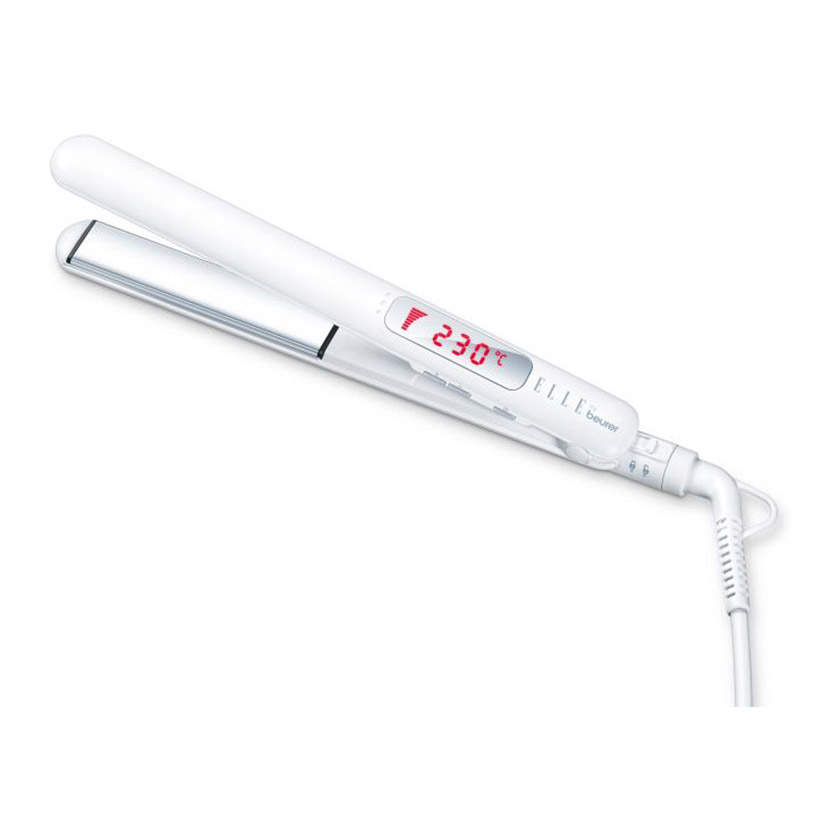
Beurer HSE 40 – The Right Flat Iron for Hair Straightening Curly Hair
The Beurer HSE 40 at Rs. 16,000 is one of the most capable straighteners in the Beurer Pakistan range for curly hair specifically. Its adjustable temperature range and ceramic plate coating provide the precise, even heat delivery that curly hair requires for thorough straightening in the minimum number of passes.
The ceramic plates on the HSE 40 distribute heat evenly across their entire surface, eliminating the hot spots that cause uneven straightening in curly hair. With a flat iron that has inconsistent plate temperatures, you might find some sections of a curl section perfectly straight while adjacent areas remain wavy — a frustrating result that tempts you into repeated passes. With the HSE 40's ceramic plates delivering consistent temperature from edge to edge, every strand in a section receives the same treatment, and single-pass results are far more uniform.
The temperature range of the HSE 40 allows curly-haired women to select the heat level appropriate for their specific curl type and density. Loose to medium curls in fine to normal Pakistani hair respond well to around 180°C to 190°C. Tighter, coarser curls in thick Pakistani hair require the higher end of the range, around 200°C to 210°C. Having this precise control is essential for curly hair because using too little heat produces a half-straight result requiring multiple passes, while too much heat causes unnecessary damage.
Step-by-Step Hair Straightening Technique for Curly Hair
After thorough blow-drying with pre-stretch, apply a heat protectant to every section before beginning with the HSE 40. Take sections no wider than one to one-and-a-half inches — smaller than you would for straight or wavy hair. Curly hair responds better to smaller sections where the flat iron can make complete contact with every strand from root to tip.
Starting at the Roots
One of the most common mistakes in hair straightening for curly hair is starting the flat iron too far from the root. Curls are most resilient at the root, where the follicle's influence on the curl pattern is strongest. Begin the HSE 40 as close to the scalp as safely possible — leaving only a small gap to avoid burning — and draw it slowly and evenly toward the tip. Keep the section taut with your free hand as you guide the iron, maintaining gentle tension throughout the pass.
Finishing Each Section
After passing the HSE 40 through a section, allow it to cool completely before releasing the tension. This is where the reshaped hydrogen bonds set in their new straight configuration. Releasing the section while it is still warm allows the bonds to partially revert toward the original curl pattern as they cool. Holding the section straight until it is fully cool locks the straight result significantly better and reduces the need for follow-up passes.
Managing Humidity After Hair Straightening Curly Hair in Pakistan
Straight-styled curly hair is vulnerable to humidity reversion — the process by which the hydrogen bonds that were temporarily straightened begin to reform in their original curly configuration when exposed to moisture in the air. In Pakistan's coastal cities like Karachi, and during the monsoon season across most of the country, humidity can be a persistent challenge for maintaining straightened curly hair.
After straightening with the HSE 40, finish with a light anti-humidity serum or spray to seal the cuticle and create a barrier against moisture absorption. Avoid stepping outside with wet hair or in heavy rain immediately after straightening. Sleeping on a silk pillowcase reduces friction and humidity exposure overnight, significantly extending how long the straight style lasts.
Protecting Curly Hair Through Regular Straightening
Curly-haired Pakistani women who straighten regularly need a consistent protective routine between sessions. The split end trimmer from Beurer Pakistan helps manage frayed ends every few weeks, preventing split end damage from travelling up the shaft. Weekly deep conditioning treatments and monthly protein treatments maintain the hair's structural integrity. On days between straightening sessions, allow hair to be its natural curly self rather than applying additional heat, giving the hydrogen bonds time to fully recover.
Frequently Asked Questions
How long does hair straightening curly hair last? Depending on your curl type, humidity levels, and hair care after styling, hair straightened with a quality flat iron like the Beurer HSE 40 typically lasts two to four days for most Pakistani women. Tighter curls revert faster than looser waves.
Can I straighten curly hair every day? Daily straightening is not recommended for curly hair. Curly hair is more fragile than straight hair and benefits from rest days between heat styling sessions. Every two to three days is a more sustainable frequency, with deep conditioning in between.
Does hair straightening curly hair permanently affect the curl pattern? With heat-only straightening tools like the HSE 40, the change is temporary. The curl pattern returns fully when hair is washed. Permanent straightening requires chemical treatments, not heat tools.
What temperature should I use for hair straightening thick, coarse curly hair? For thick, coarse Pakistani curly hair, the Beurer HSE 40's higher temperature settings — around 200°C to 210°C — are appropriate when used with a heat protectant. Always start at a lower setting and increase only if the result is insufficient.
Why does my curly hair go frizzy immediately after straightening? This is almost always caused by residual moisture in the hair at the time of flat ironing, or by the cool shot step being skipped. Ensure hair is completely dry before using the HSE 40, finish each section with cool air from a hair dryer, and apply an anti-humidity serum after styling.
Conclusion
Hair straightening curly hair is entirely achievable at home when approached with the right preparation, the right tools, and the right technique. The Beurer HSE 40 at Rs. 16,000, available through Beurer Pakistan, provides the ceramic plate quality, temperature precision, and reliable German engineering that curly Pakistani hair demands for smooth, lasting results. Visit beurer.pk to order today with cash on delivery and nationwide shipping across Pakistan.